


The coordinator spent 45 minutes personalizing each major donor communication. Impact Story Match does it in 45 seconds. More accurate than the manual version.
The major donor stewardship letter used to take 45 minutes.
Reading the donor file. Identifying the program areas they had expressed interest in. Selecting the appropriate impact story. Calibrating the ask amount to the current relationship stage. Writing a letter that reflected all of those considerations in a way that felt genuinely personal. Forty five minutes per letter. At 50 major donor stewardship communications per year, that is 37.5 hours going to a task that the Impact Story Match and Impact Summary Generator complete in 45 seconds.
The First Agent Finds the Right Story
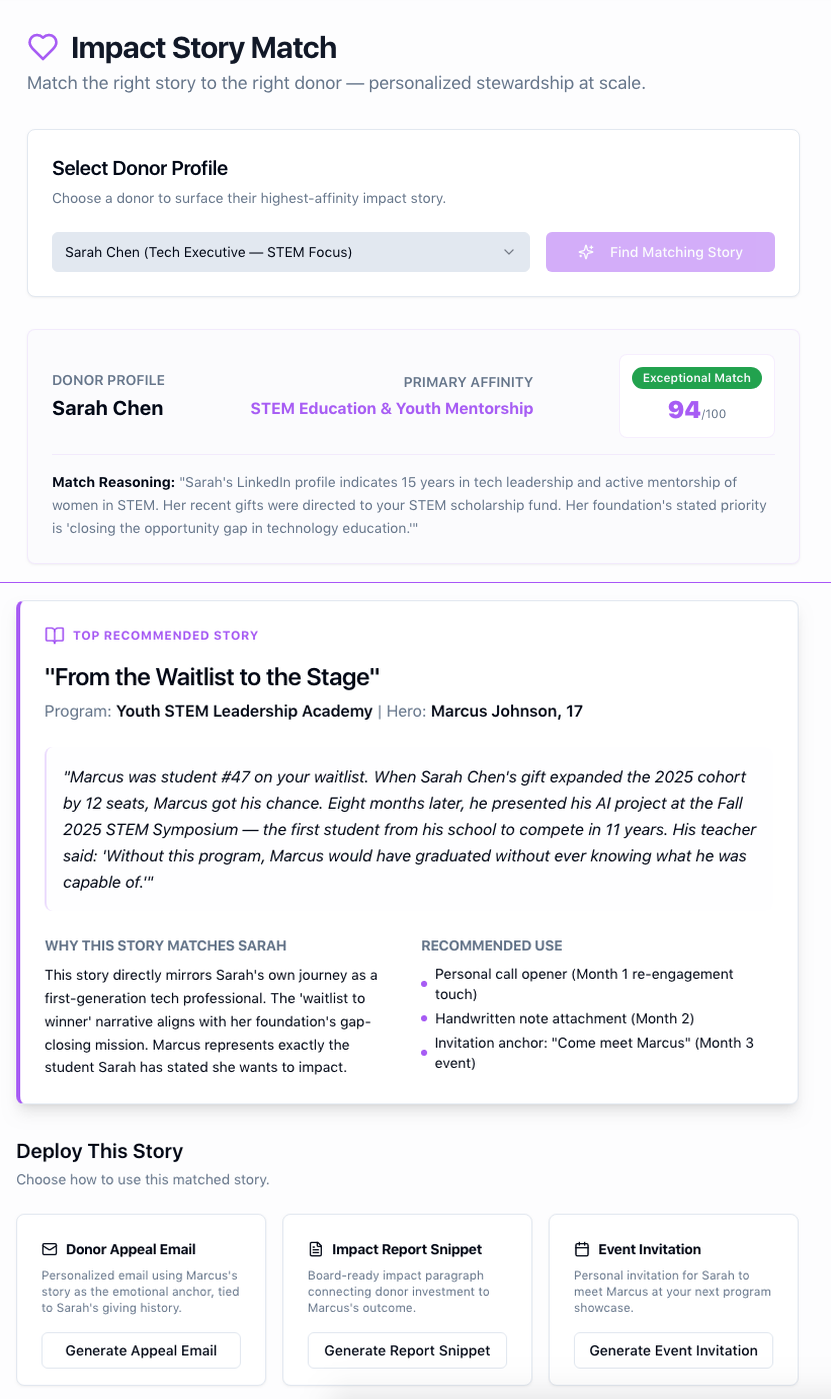
The Impact Story Match analyzes each donor's complete profile and identifies the specific program story most likely to resonate with them. Not the most recent story. The story whose programmatic content, outcome type, and narrative register most closely aligns with what this donor's engagement history indicates they will respond to most deeply.
The Second Agent Turns the Match Into a Draft
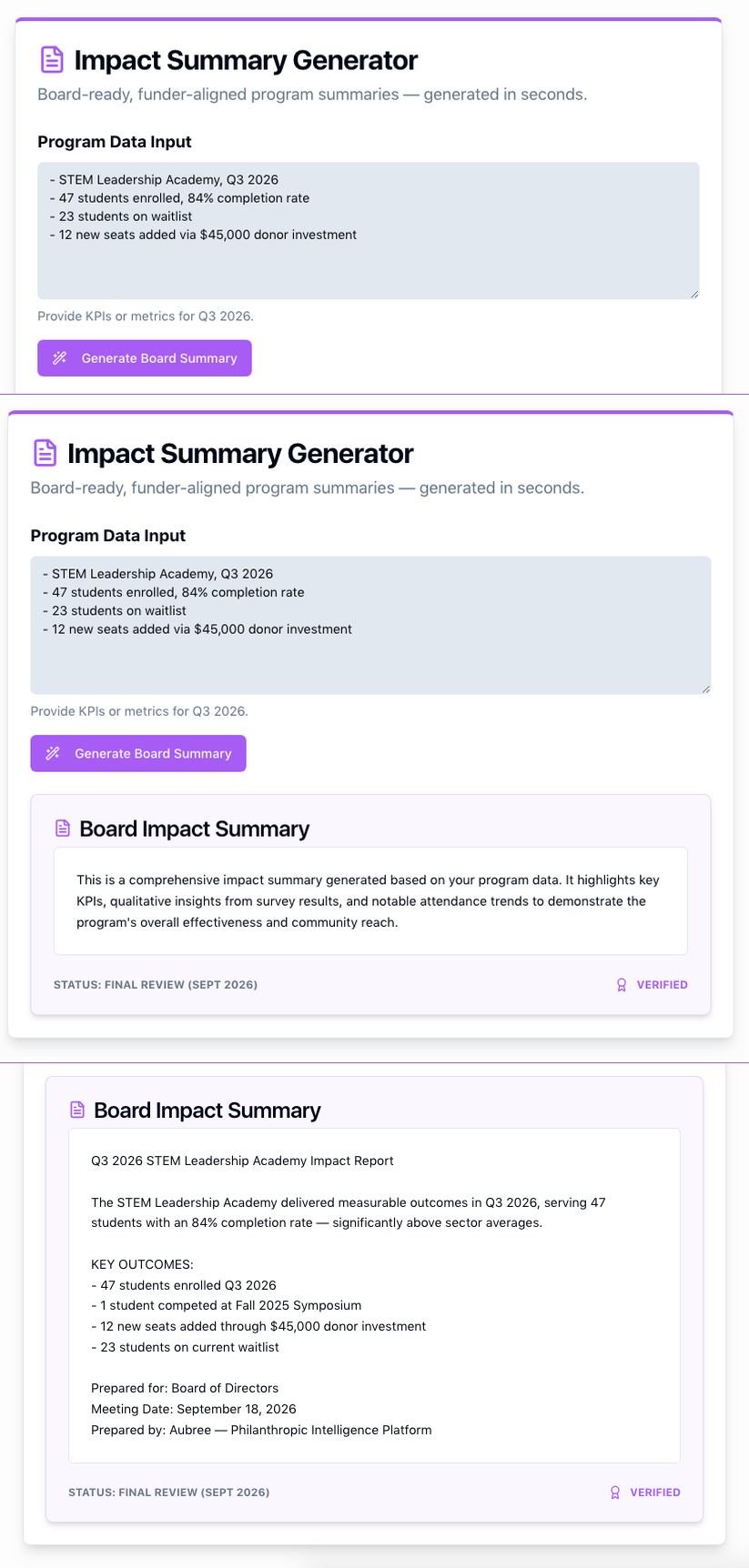
The Impact Summary Generator produces a personalized stewardship communication. The donor's name. Their specific program connection. The matched impact story. The appropriate stewardship message calibrated to the relationship stage. The coordinator reviews the draft in 45 seconds. She personalizes one or two sentences based on institutional knowledge the system does not have access to. She sends.
Why the Faster Version Is More Accurate
Why the 45 second version is more accurate: the 45 minute manual process depends on the coordinator's ability to remember and synthesize four years of relationship history in the time it takes to prepare a letter. The Impact Story Match has access to every data point in the donor's complete profile simultaneously. It does not forget the three year old survey response. It does not overlook the engagement signal that appeared in last month's newsletter data. The personalized letter the system produces reflects a more comprehensive understanding of the donor's relationship with the organization than the coordinator can hold in active memory at any given moment.
Speed is only the visible improvement. Consistency is the operational gain. Every donor moves through the same complete review. Every story is selected against the same evidence. Every draft reflects the donor's current relationship stage instead of whichever detail happens to be easiest for a busy coordinator to recall.
The Workflow Changes, Not the Human Judgment
The coordinator is not removed from stewardship. She moves to the part of stewardship that requires her. The agents gather and synthesize the full relationship record. She reviews the draft, adds the detail only a colleague would know, checks the tone, and decides when the message should be sent.
What the Team Does With the Time
In the year following deployment, the development coordinator redirected 37.5 hours from stewardship letter production to relationship work. She completed 15 major donor cultivation calls she had been scheduling and rescheduling for months. Three resulted in gift upgrades. One resulted in a planned giving conversation. She attended four program site visits she had not had time to schedule. She built a stewardship calendar for the following year that mapped every major donor touchpoint to a specific relationship stage. The letters are better. The relationship is deeper. The 37.5 hours are doing something more valuable.
This is the operating model behind scalable personalization. The intelligence layer handles complete recall and rapid synthesis. The coordinator handles trust, judgment, and the next conversation. One does not replace the other. Each makes the other more valuable.
For operations leaders, the decision is not whether a machine can write a letter. It is whether highly capable staff should keep spending 45 minutes reconstructing information the organization already owns. StewardWise AI turns that information into relationship readiness in seconds.
See where the intelligence layer can return staff time and strengthen donor relationships across your organization.
Show Me My AI Workforce Blueprint →